

ERP Strategy: Full Suite or Best-Fit Software Integration?
ERP Strategy: Full Suite or Best-Fit Software Integration?
21 Jan
Should You Implement a Full ERP Suite or a Best-Fit Integrated Software Strategy?
In today’s competitive and fast-moving business environment, executives are under constant pressure to improve efficiency, accuracy, and speed of execution.
At Consulting Group, we help organizations design ERP strategies that are pragmatic, scalable, and aligned with real business needs.
Understanding the Role of ERP in Modern Organizations
An Enterprise Resource Planning (ERP) system centralizes financial, operational, and administrative data into a single platform. When implemented correctly, it becomes the single source of truth for the organization.
- Financial control and compliance
- Centralized master data
- Cross-department visibility
- Standardized business processes
However, ERP systems are not always the most efficient solution for every specialized business function.
Full ERP Suite: Advantages and Limitations
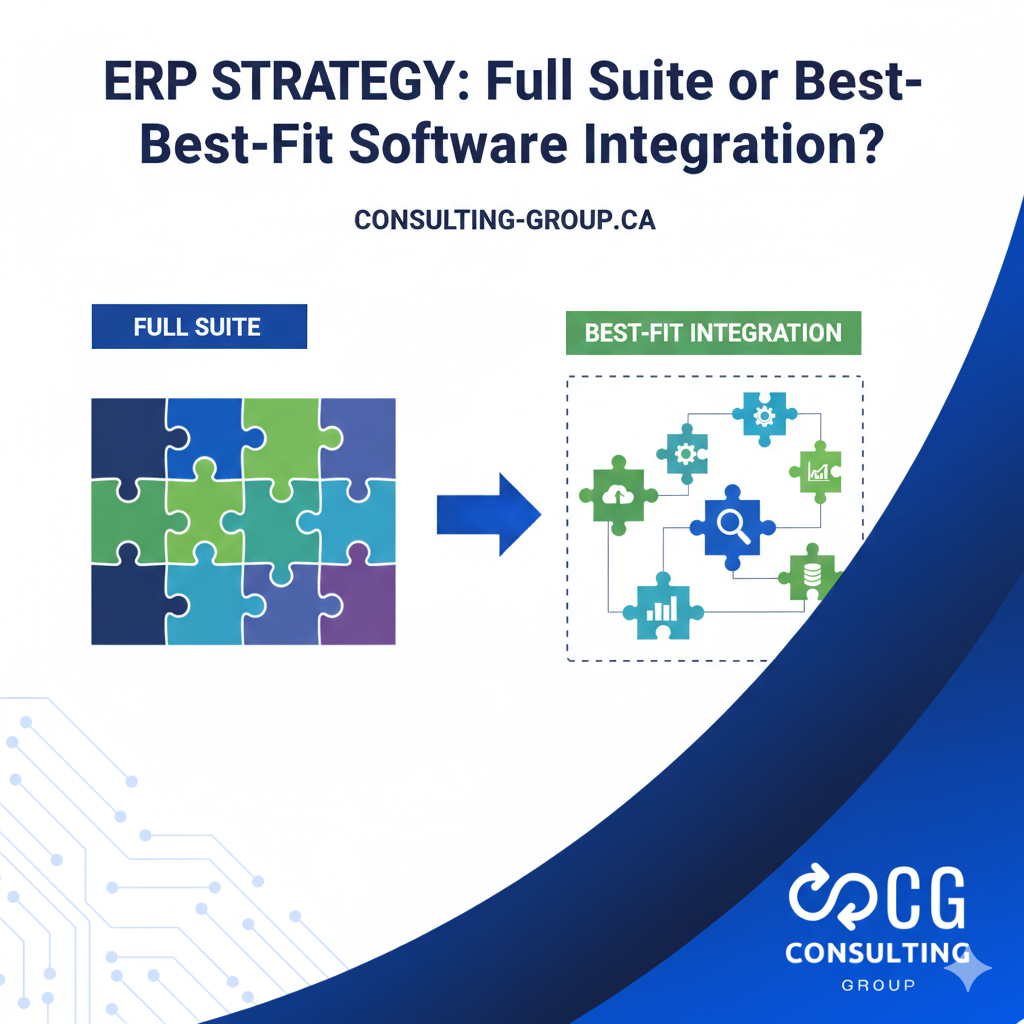
A full ERP implementation involves deploying all available modules from a single vendor, such as finance, procurement, HR, CRM, and operations.
Advantages
- Unified vendor ecosystem
- Consistent data structure
- Simplified governance and compliance
Limitations
- Not all modules are best-in-class
- Customization increases cost and complexity
- Slower adoption due to rigid workflows
- Limited agility as the business evolves
In many cases, organizations end up with an over-engineered system that does not deliver the expected operational efficiency.
Best-Fit Software Integrated with ERP: A Strategic Alternative
A best-fit strategy uses the ERP for core functions—especially finance and reporting—while integrating specialized software where it adds the most value.
- Advanced CRM platforms integrated with ERP finance
- Specialized HR or payroll systems
- Project management and forecasting tools
- Business intelligence and analytics platforms
This approach often results in faster deployment, better user adoption, and a lower total cost of ownership.
ERP as the Source of Truth: A Non-Negotiable Principle
Regardless of the architecture chosen, one principle must always be respected: the ERP remains the authoritative source of truth.
- Accurate and auditable financial data
- Reliable executive reporting
- Strong data governance
- Elimination of data silos
Integrated systems should enrich the ERP, not replace it.
How Executives Should Make the Decision
- Focus on business outcomes, not software features
- Analyze workflow efficiency and pain points
- Compare ERP modules with specialized tools
- Design integrations carefully to ensure scalability and security
- Evaluate total cost of ownership, not just licensing
Conclusion: Build an ERP Strategy That Works
A successful ERP strategy is not about implementing every available module. It is about choosing the right components, maintaining flexibility, and ensuring data integrity.
For many organizations, the optimal approach is:
- ERP as the financial and data backbone
- Best-fit specialized software for critical workflows
- Strong integration to support speed and accuracy
Consulting Group supports executives in defining ERP roadmaps, selecting the right technologies, and delivering integrations that improve performance without unnecessary complexity.
to discuss your ERP strategy and integration roadmap.

- Address
- 900 Bd Curé-Labelle, Laval, QC H7V 0C8
- Phone
- +1 514 591 9215
- contact@consulting-group.ca