

Software ROI for CEOs: OpEx vs CapEx and the True Cost of SaaS
Software ROI for CEOs: OpEx vs CapEx and the True Cost of SaaS
18 Jan
When executives approve new software—whether it’s an ERP upgrade, AI automation, or a customer management platform—the decision often starts with a simple comparison: monthly subscription versus upfront build cost.
On paper, Software-as-a-Service (SaaS) looks like the safe choice. Low entry cost. Fast deployment. Minimal commitment. Custom software, by contrast, appears expensive and risky.
But this comparison is fundamentally flawed. Software decisions are financial architecture decisions, not procurement choices.
To evaluate them correctly, leaders must analyze software through four financial lenses: OpEx, CapEx, RevEx, and FinEx.
1. OpEx: The Silent Drain of Subscription Software
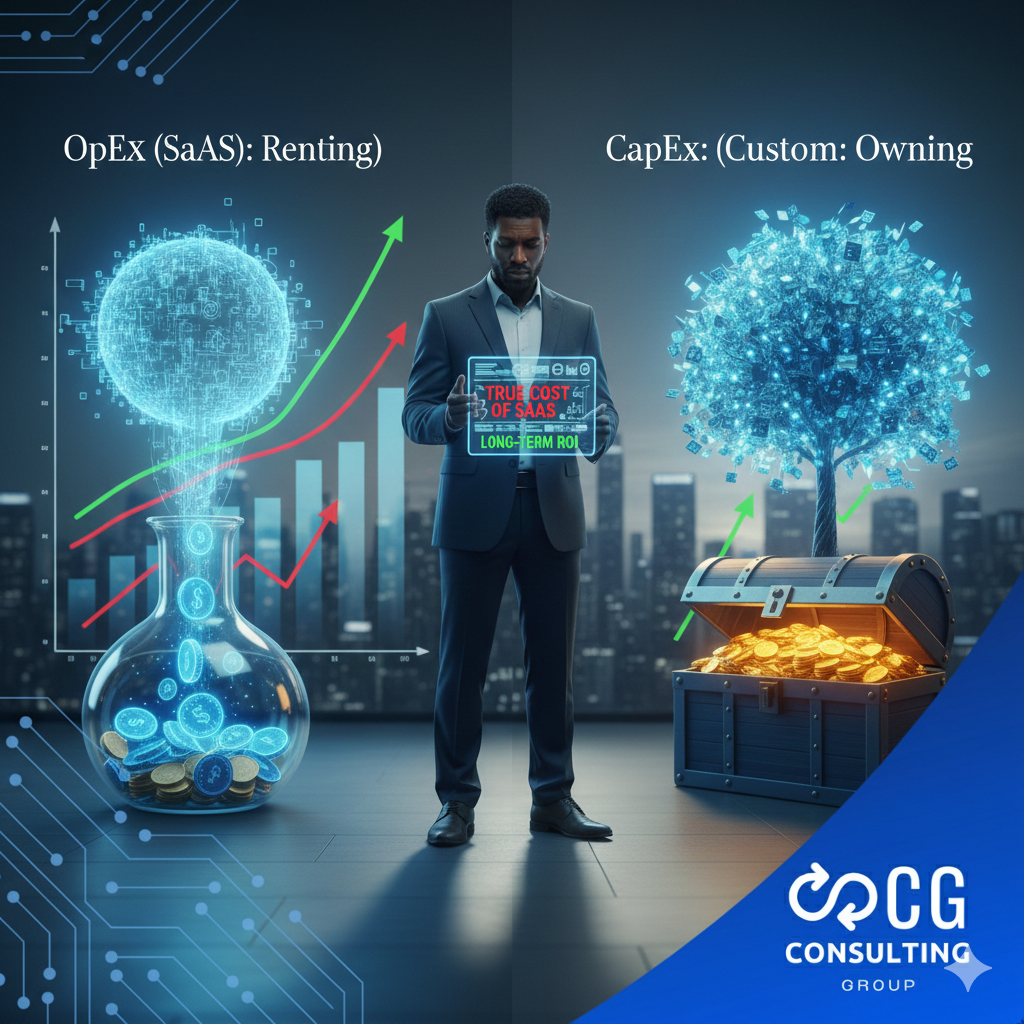
Operating Expenditure (OpEx) includes recurring costs required to keep the business running. SaaS lives entirely in this category.
The Growth Tax Problem
- Per-user pricing
- Per-transaction fees
- Per-record or data limits
As your business scales, SaaS costs scale faster than revenue—creating a hidden growth tax on success.
2. CapEx: Turning Software Into a Balance Sheet Asset
Capital Expenditure (CapEx) represents investments that deliver long-term value. Custom software fundamentally changes the equation.
Custom Software = Intellectual Property
When you build custom software, you create proprietary IP that:
- Lives on your balance sheet
- Increases company valuation
- Is fully owned by your organization
Unlike SaaS, custom software costs are capitalized and depreciated over time, smoothing profit impact and improving financial stability.
3. RevEx: The Hidden Cost Nobody Calculates
Revenue Expenditure (RevEx) measures the direct cost of generating revenue. This is where generic software quietly erodes margins.
The Inefficiency Tax
When software doesn’t match real workflows, employees compensate with:
- Manual data entry
- Spreadsheet bridges
- Process delays
15 employees losing 40 minutes per day equals over 2,500 hours per year. At $45/hour, that’s $112,500 in lost productivity—annually.
4. FinEx: The True Cost of Capital
Finance Expenditure (FinEx) reflects the cost of money, including interest and opportunity cost.
While custom software may require upfront capital, the ROI from eliminating multiple SaaS tools and automating revenue workflows often exceeds financing costs.
SaaS vs Custom Software: Financial Comparison
| Dimension | SaaS Model | Custom Software Model |
|---|---|---|
| Primary Category | OpEx (Recurring) | CapEx (Asset) |
| Scaling Cost | Linear Increase | Fixed / ROI Improves |
| Process Fit | Generic | Exact Workflow Match |
| Ownership | None | Full IP Ownership |
| Valuation Impact | Zero | Increases Enterprise Value |
The Executive Takeaway
Choosing software based on monthly price alone is a strategic mistake. SaaS is ideal for commodity tools, but core revenue systems require ownership, efficiency, and leverage.
Custom software eliminates growth taxes, removes inefficiency, and transforms technology spend into a long-term asset.
Engineering Software That Pays for Itself
At CG Consulting Group, we specialize in turning software into financial leverage. From custom ERPs, custom software to AI-driven automation, we help leaders convert technology from an expense into a profit engine.
Stop renting your efficiency. Start owning it.
Not sure if SaaS or custom software is the right move?
Get a clear financial breakdown before you invest.


- Address
- 900 Bd Curé-Labelle, Laval, QC H7V 0C8
- Phone
- +1 514 591 9215
- contact@consulting-group.ca