

Why OEM Suppliers Use Excel First Despite SAP or Oracle ERP
Why OEM Suppliers Use Excel First Despite SAP or Oracle ERP
12 Jan
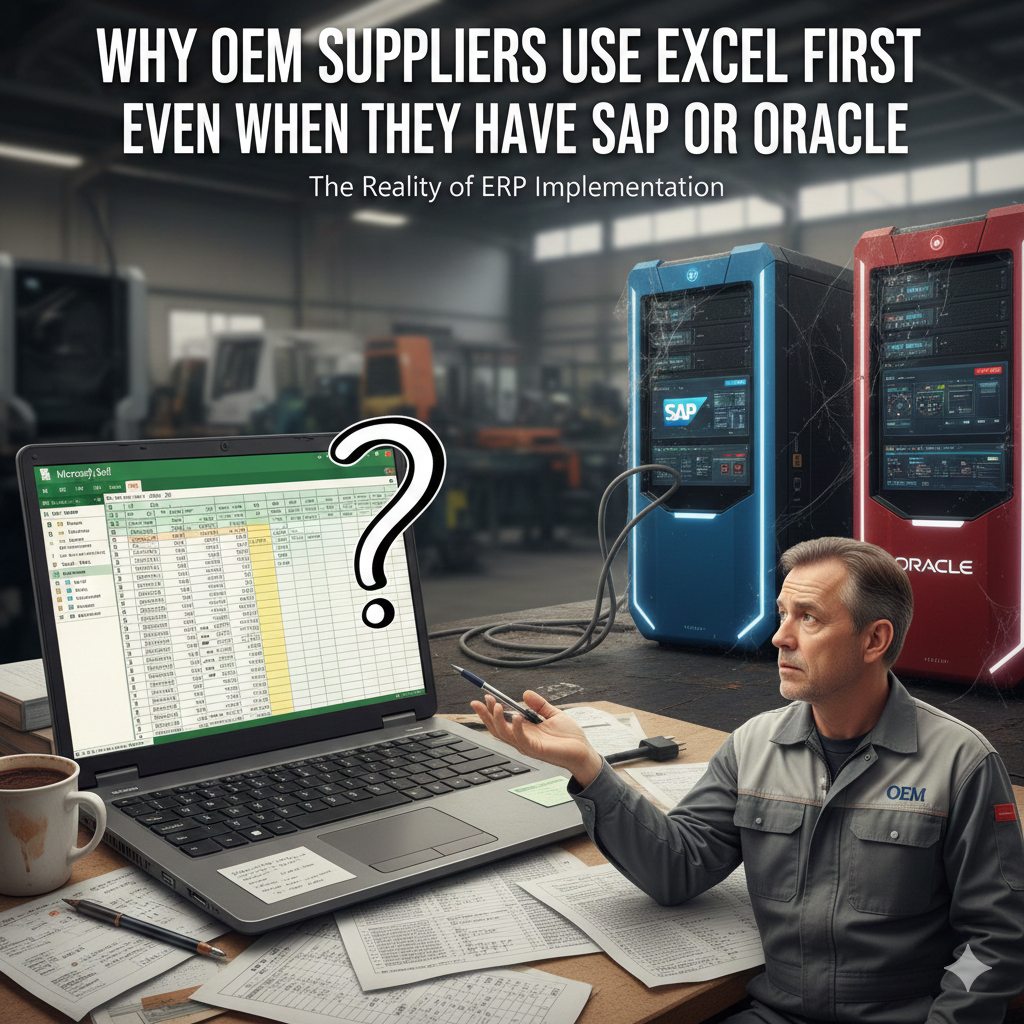
Many OEM suppliers have invested heavily in ERP systems like SAP or Oracle. On paper, their accounting processes are fully integrated, controlled, and standardized.
In practice, much of the real accounting work still happens in Excel.
Spreadsheets are used to calculate, reconcile, clean, and validate financial data—only after that are the final results entered into the ERP. This disconnect creates inefficiency, operational risk, and frustration across finance teams.
Excel as the “Shadow Accounting System”
Despite having SAP or Oracle, finance teams often rely on Excel to:
- Clean and reconcile Accounts Receivable balances
- Prepare cash application files
- Match payments to invoices
- Analyze aging, short pays, and disputes
- Calculate adjustments before posting
Excel becomes the place where numbers are made right, while the ERP is used primarily to store the final outcome.
This effectively creates a shadow accounting system running outside SAP or Oracle.
Why Finance Teams Don’t Work Directly in the ERP
This behavior isn’t driven by laziness or resistance to change—it’s driven by practicality.
ERP systems are powerful, but for day-to-day operational accounting they are often:
- Rigid and difficult to adapt
- Complex to navigate for detailed reconciliation work
- Slow for high-volume AR activities
- Dependent on IT or strict posting controls
Excel, by contrast, offers speed and flexibility. Finance teams can quickly manipulate data, test scenarios, and resolve issues before touching the ERP.
That flexibility, however, comes at a cost.
Double Work, Double Risk
When accounting work starts in Excel and ends in SAP or Oracle, organizations introduce:
- Duplicate effort across systems
- Manual data entry back into the ERP
- Higher risk of posting errors
- Limited or fragmented audit trails
- Version control and spreadsheet governance issues
By the time data reaches the ERP, it has often been transformed and reworked multiple times—without full transparency or traceability.
Accounts Receivable and Cash Application Are Hit the Hardest
This Excel-first approach is most common in Accounts Receivable and cash application.
Typical scenarios include:
- Payments matched to invoices in Excel
- Remittance details manually interpreted
- AR cleanup performed outside the ERP
- Only final applied amounts posted to SAP or Oracle
As a result, the ERP shows what happened—but not how it happened—making root-cause analysis, dispute tracking, and process improvement extremely difficult.
When the ERP Becomes a Reporting Tool Only
In these environments, SAP or Oracle slowly stops functioning as an operational accounting system and becomes:
- A compliance platform
- A financial reporting database
- A historical record of posted entries
The real accounting work lives elsewhere.
This undermines the value of the ERP investment and keeps finance teams locked into manual, spreadsheet-driven processes.
The Real Problem: Missing Operational Accounting Tools
The issue is not Excel.
The issue is not the ERP.
The real problem is the gap between operational accounting work and ERP capabilities.
Finance teams need systems that:
- Work alongside SAP or Oracle
- Automate AR matching and cleanup
- Preserve full audit trails
- Reduce manual intervention
- Feed clean, validated data into the ERP
When this layer is missing, Excel fills the gap—imperfectly.
Moving from Excel-First to System-First Accounting
The goal is not to eliminate Excel entirely. The goal is to:
- Use Excel for analysis, not operations
- Automate repetitive AR and cash application tasks
- Push structured, accurate data into SAP or Oracle
- Restore the ERP as the single source of truth
When operational accounting becomes system-driven, month-end closes accelerate, AR stays clean, and finance teams regain control.
Final Thought
OEM suppliers don’t lack systems—they lack flow.
When accounting work starts in Excel and ends in an ERP, inefficiency is inevitable. The companies that close this gap stop fighting their tools and start letting their systems work together.


- Address
- 900 Bd Curé-Labelle, Laval, QC H7V 0C8
- Phone
- +1 514 591 9215
- contact@consulting-group.ca