

From Prototype to Production: Why Enterprise Software Still Requires Engineering
From Prototype to Production: Why Enterprise Software Still Requires Engineering
07 Aug
A CFO builds a cash-flow forecasting tool over a weekend, using an AI coding assistant instead of a finance analyst and a developer.
An operations manager at a distribution company prompts her way to a scheduling app that used to require a six-month vendor contract.
A marketing director spins up a customer segmentation tool in an afternoon, no ticket filed with IT, no developer involved.
None of this was possible three years ago. All of it is now routine, and none of it is actually finished.
The One-Weekend Prototype Is Now Normal
A CFO builds a cash-flow forecasting tool over a weekend, using an AI coding assistant instead of a finance analyst and a developer.
An operations manager at a distribution company prompts her way to a scheduling app that used to require a six-month vendor contract.
A marketing director spins up a customer segmentation tool in an afternoon, no ticket filed with IT, no developer involved.
Instead of simply buying software, employees are now building software.
This is not a niche behavior confined to engineering teams. It is happening in finance, operations, sales, and marketing, across companies that have never had an internal development team.
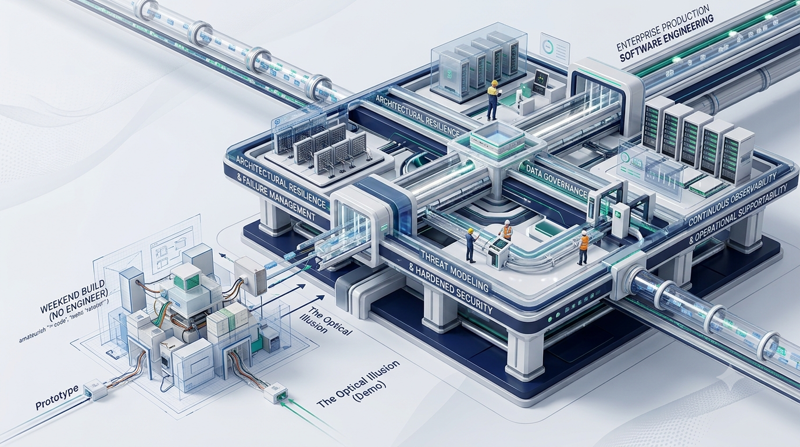
A Working Demo Is Not a Production System
The prototype does exactly what it was asked to do, once, for one user, with clean data, on one laptop.
A production system has to do the same thing correctly for hundreds of users, with messy data, five years from now, while nobody who built it still works at the company.
Those are two different engineering problems. AI has made the first one nearly free. It has not made the second one go away.
The distance between "it worked when I demoed it" and "it works" is where most enterprise software projects actually live.
Where the Risk Actually Hides
A prototype rarely has authentication. It rarely has a backup. It often runs on a personal account, a personal laptop, or a free-tier cloud service that nobody in IT knows exists.
None of that matters while the tool is a side project. It matters enormously the day someone connects it to real customer records, real financial data, or a live operational process.
The risk is not that the prototype fails. Prototypes fail safely, someone notices and starts over.
The risk is that the prototype succeeds, quietly becomes load-bearing, and nobody ever goes back to engineer it properly.
Six Things Every AI-Built Prototype Is Missing
The gap between a prototype and a production system is not cosmetic. It is a specific, recurring list of engineering work that AI tools do not do on their own:
- Authentication and access control, who is allowed to see and change what
- Input validation and error handling, what happens when the data is messy, missing, or malicious
- Data governance and audit trail, where data lives, who can access it, and how changes are logged
- Security testing, whether the tool can be probed, breached, or used to reach other systems
- Performance under real load, what happens with 200 concurrent users instead of one
- A named owner and a support plan, who fixes it at 2 a.m. when it breaks
A prototype can be brilliant and still be missing all six.
What It Costs When Nobody Closes the Gap
The bill rarely arrives on day one. It arrives twelve to eighteen months later, once the prototype has quietly become part of how the business runs.
By then, rebuilding it properly costs more than building it right the first time would have, because now it also has to be rebuilt without disrupting the process that depends on it.
A data leak or outage from an ungoverned tool costs far more than the tool ever saved in consulting or licensing fees. Regulators, customers, and boards do not distinguish between "official system" and "prototype someone built with AI" when a breach happens.
And when the employee who built it leaves the company, the knowledge of how it actually works usually leaves with them.
Prototype vs. Production-Grade System
The two are often visually identical. The difference is entirely underneath the surface.
| Dimension | AI Prototype | Production-Grade System |
|---|---|---|
| Purpose | Prove an idea works | Run a business process reliably |
| Users | One, usually the builder | Many, concurrently, over years |
| Data handling | Sample or test data | Real, sensitive, regulated data |
| Failure mode | Restart and try again | Must degrade safely, log, and recover |
| Ownership | One person, informally | A named team, formally |
| Security | Rarely reviewed | Tested, monitored, patched |
| Lifespan | Days to weeks | Years |
Why AI Widened the Gap Instead of Closing It
Because prototyping is now nearly free, the number of prototypes has exploded. Every department can produce one, and most now do.
The bottleneck used to be "can we build this at all." That question has been answered. The bottleneck is now "who is going to engineer this properly, and when."
Most IT and engineering teams were sized for a world where a handful of projects reached them each quarter. They are not sized for a world where every department produces working software every week.
AI did not remove the engineering step. It moved the pressure onto it.
From Shadow IT to Shadow AI
Shadow IT used to mean an unauthorized SaaS subscription on someone's expense report. It was a procurement problem.
Shadow AI is different. It means a live business process, pricing, scheduling, forecasting, customer communication, running on a tool nobody in IT has reviewed, secured, tested, or backed up.
It is not a procurement problem. It is an operational and security exposure sitting inside the business, often touching the same customer and financial data that the rest of the company spends significant effort protecting.
Most executive teams can name their SaaS spend. Very few can name every AI-built tool currently running a real process inside their company.
Prototype Debt Is the New Technical Debt
Technical debt used to accumulate slowly, one shortcut at a time, inside systems that IT already knew about.
Prototype debt accumulates differently. It appears fully formed, outside IT's view, the moment someone finishes a working prompt session.
Every prototype that quietly becomes load-bearing is a liability the company is carrying without knowing it, no line on a balance sheet, no ticket in a backlog, no owner accountable for it.
The faster prototypes get built, the faster this liability compounds unless something is actively converting them into engineered systems.
What Good Governance Looks Like
Governance here does not mean slowing prototyping down. Prototyping should stay fast, that speed is a genuine advantage.
It means putting a deliberate checkpoint between "this works as a demo" and "this now runs a business process." Before an AI-built tool touches real customer data or becomes part of a live process, it should pass through:
- An inventory step, someone in IT knows the tool exists
- A risk classification, what data it touches and what happens if it fails
- An engineering review, security, error handling, and scalability assessed against how it will actually be used
- A named owner, a person or team accountable for it once it is live
- A maintenance budget, time and cost allocated to keep it running, not just to build it
None of this requires banning employees from building. It requires deciding, deliberately, which prototypes deserve to graduate, and engineering them properly when they do.
What Leaders Should Measure
Most executive teams track cloud spend and project timelines. Very few track the metrics that actually reveal this risk.
- Number of AI-built tools currently running a business process without IT review
- Percentage of business-critical workflows dependent on software with no named owner
- Average time from "working prototype" to "engineered, supported system"
- Number of incidents — outages, data issues, security findings — traced back to ungoverned tools
None of these numbers show up in a standard IT dashboard. They have to be asked for.
Engineering Discipline Is the Next Competitive Advantage
Every competitor can now prototype quickly. That is no longer a differentiator, it is table stakes.
The advantage is shifting to whichever organizations can reliably and repeatedly turn a good prototype into a secure, scalable, maintainable system, without losing the speed that made the prototype possible in the first place.
That is not a tooling problem. It is an engineering and governance discipline, and it is where the next round of enterprise technology advantage will actually be won.
The companies that treat AI prototyping as the finish line will spend the next few years quietly paying for it. The ones that treat it as the starting line will be the ones still standing.


- Address
- 900 cure labelle laval
- Phone
- contact@consulting-group.ca