

Why AI Doesn't Eliminate Software Development
Why AI Doesn't Eliminate Software Development
02 Aug
Every few months, a new claim circulates in executive circles: AI can now write software, so the software development function can shrink, or disappear. It's an appealing story for anyone staring down a technology budget line. It's also incomplete.
AI can propose an implementation. It can turn a prompt into working code, draft a function, or sketch an architecture in seconds. What it cannot do is decide what problem that code is supposed to solve for your organization, that responsibility still sits with people who understand the business, its constraints, and what "correct" actually means in context.
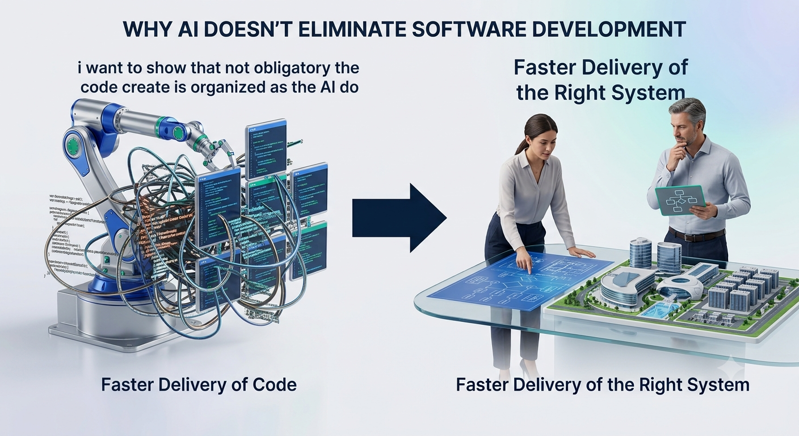
For a CEO or CFO, this distinction is not academic. It determines whether you're funding faster delivery of the right system, or faster delivery of the wrong one. The gap between "AI generated code" and "AI generated the right software" is exactly where budgets get burned and timelines slip.
This article looks at what AI genuinely changes in software development, what it doesn't, and how leaders should adjust their expectations, their measurements, and their engineering teams accordingly , especially as the environment they're operating in grows more complex.
The Promise Behind the Headlines
AI coding assistants can generate functioning code from a plain-language prompt in seconds, and that capability is real. It has understandably fed a boardroom narrative: if a machine can produce code, software development is becoming a commodity, and headcount or budget in that area can be cut accordingly.
The narrative skips a step. Writing code and building software are not the same activity. Code is the output; software is the output validated against a specific problem, in a specific organization, under specific constraints. AI is genuinely fast at the first. It has no access to the second.
What AI Actually Does Well
Used properly, AI is a strong accelerator inside the development process. It can draft boilerplate, translate a well-specified requirement into working code, generate test scaffolding, or offer several implementation options for a given function. Teams that use it this way ship faster on the parts of the work that were always mechanical.
That value is real and worth capturing. It's also narrower than the headlines suggest: AI is proposing an implementation, not deciding whether that implementation is the right one for your business.
The Part AI Cannot Do: Define the Problem
An AI system responds to the problem it is given. It has no way to know which trade-offs matter to your organization, which edge cases are commercially unacceptable, which regulatory obligations apply to this specific data, or what "done" means for this specific customer base. That definition work , the hardest and highest-value part of software development, still belongs to people.
Two companies can prompt an AI for the same inventory management feature and receive nearly identical code. Only the one that correctly specified its constraints, multi-warehouse consistency rules, audit retention requirements, how to handle a negative stock count, ends up with software that actually fits its business. The other ends up with code that compiles and runs, and quietly fails the first time reality doesn't match the assumptions nobody stated.
Where This Goes Wrong in Practice
The failure mode is rarely a dramatic outage. It's a slow accumulation of small, silent decisions made by default rather than by design.
- Ambiguous requirements get resolved silently inside the generated implementation, instead of being flagged back to the business for a decision.
- Edge cases the business actually cares about are never mentioned in the prompt, so they're never handled, and surface first in production.
- Architectural choices get bundled invisibly into a plausible-looking implementation, without anyone deciding whether that architecture is the right one to commit to.
- Nobody validates that the generated logic matches the actual business rule until a customer, auditor, or incident forces the question.
- Technical debt accumulates faster than before, because generation now outpaces the review discipline needed to catch it.
Complexity Is the Variable That Decides the Outcome
The riskiness of "let AI propose the implementation" scales directly with the complexity of the environment it's operating in. In a simple, well-bounded task, a wrong assumption is cheap to spot and cheap to fix. In a complex, interconnected environment, the same wrong assumption can propagate for months before anyone notices.
| Dimension | Low-complexity task | High-complexity environment |
|---|---|---|
| Integrated systems affected | One, isolated | Many, interdependent |
| Cost of a wrong assumption | Low, easy to catch early | High, often discovered late |
| Regulatory or compliance exposure | Minimal | Significant |
| Tolerance for ambiguity in requirements | High | Very low |
| Role of engineering judgment | Helpful | Decisive |
Why This Isn't a Coding Problem
As complexity rises , more integrated systems, more stakeholders, more regulatory exposure , the number of implicit decisions embedded in any implementation rises with it. AI has no mechanism to know which of those decisions actually matter to your organization. It will produce a plausible answer regardless of whether anyone asked the right question.
Engineering judgment is precisely the discipline of surfacing those decisions before they become defects: recognizing which requirement is actually ambiguous, which dependency will break under load, which "reasonable" default will conflict with how your business really operates. The more complex the environment, the more that judgment is the thing you're actually paying for.
A Framework: Where Judgment Must Stay in the Loop
Rather than treating AI adoption as a binary , replace developers or don't , it's more useful to separate software delivery into three layers and decide where AI fits in each.
- Problem definition: stays with people who understand the business, the constraints, and the consequences of getting it wrong. Not delegable to AI.
- Implementation proposal: where AI adds real speed , drafting code, testing scaffolding, exploring options , under direction from a defined problem.
- Verification and integration judgment: requires experienced engineers who can evaluate whether the proposed implementation actually solves the defined problem, inside your specific systems and constraints.
Organizations that collapse the second layer into the first , letting the AI's implementation stand in for problem definition , are the ones most exposed when the environment gets complex.
What CEOs and CFOs Should Measure
"Time to first commit" or "lines of code generated" are the wrong signals for whether AI adoption is actually working. They measure output, not fit. Leaders should instead track indicators that reveal whether the definition and judgment layers are keeping pace with the increase in generated code.
- Rework rate: how much AI-assisted code gets substantially revised after initial delivery.
- Production incidents traced back to unclear or unstated requirements rather than coding errors.
- Senior engineering review time as a share of total delivery time, and whether it's shrinking faster than it safely should.
- Time spent on problem definition and specification before implementation begins, relative to time spent generating code.
Rethinking the Engineering Budget, Not Cutting It
The organizations getting real value from AI in software development aren't the ones cutting engineering headcount across the board. They're the ones changing its composition , shifting investment away from repetitive implementation work and toward the people who can define problems precisely and judge whether a proposed solution actually fits a complex environment.
That shift favors experience. Judgment about which requirements are load-bearing, which risks are acceptable, and which shortcuts will cost you later is built through exposure to complex systems over time , it's not a byproduct of faster code generation.
The Path Forward
AI is a genuine and growing accelerator for software delivery. It is not a substitute for the responsibility of defining what needs to be built, or for the judgment required to verify that what gets built actually holds up inside a complex, real-world environment.
The leaders who get the most out of AI in this space won't be the ones who eliminated software development. They'll be the ones who kept engineering judgment firmly in place while letting AI do more of the typing.


- Address
- 900 cure labelle laval
- Phone
- contact@consulting-group.ca