

The Hidden Cost of AI-Generated Software
The Hidden Cost of AI-Generated Software
31 Jul
Artificial Intelligence has changed the way companies create software. What once required months of planning, development teams, architects, and significant budgets can now be accomplished in hours by employees using AI coding assistants and generative AI platforms.
A marketing manager can create an internal reporting tool. A finance analyst can automate invoice processing. A customer service manager can build an AI assistant. A department director can create a workflow application without involving IT.
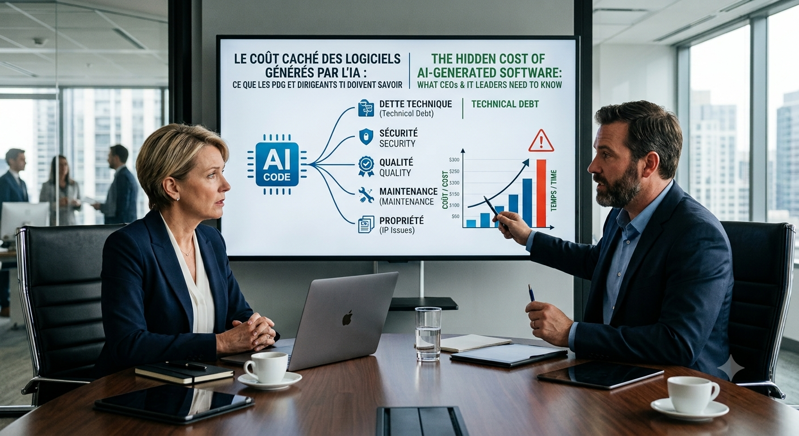
This new capability creates enormous business opportunities, but it also introduces a challenge many executives are not prepared for: the hidden cost of AI-generated software.
The initial creation cost may appear almost free, but the long-term costs related to security, maintenance, governance, scalability, compliance, and business continuity can become significant.
Artificial Intelligence has changed the way companies create software. What once required months of planning, development teams, architects, and significant budgets can now be accomplished in hours by employees using AI coding assistants and generative AI platforms.
A marketing manager can create an internal reporting tool. A finance analyst can automate invoice processing. A customer service manager can build an AI assistant. A department director can create a workflow application without involving IT.
This new capability creates enormous business opportunities, but it also introduces a challenge many executives are not prepared for: the hidden cost of AI-generated software.
The initial creation cost may appear almost free, but the long-term costs related to security, maintenance, governance, scalability, compliance, and business continuity can become significant.
The New Era of Software Creation
For decades, software development followed a structured model. Businesses identified a need, created requirements, designed an architecture, developed the solution, tested it, deployed it, and maintained it.
AI has disrupted this traditional approach.
With tools such as AI coding assistants, business users can generate applications, scripts, integrations, dashboards, and automation workflows with minimal technical knowledge.
This movement is often called citizen development or AI-assisted development. It allows organizations to accelerate innovation and reduce dependency on development teams.
However, software creation is only one part of the lifecycle. The real cost begins after the application is created.
The Hidden Difference Between Creating Software and Operating Software
Many organizations focus only on the cost of building an application.
AI makes creation inexpensive, but enterprise software requires much more than code generation.
| Software Creation | Software Operation |
|---|---|
| Generating code | Maintaining code |
| Creating prototypes | Managing production systems |
| Building workflows | Monitoring reliability |
| Testing basic scenarios | Managing security risks |
| Solving an immediate problem | Supporting long-term business needs |
The fastest application to build is not always the cheapest application to own.
AI-Generated Software Creates a New Type of Technical Debt
Traditional technical debt comes from rushed development, outdated frameworks, poor architecture, or insufficient testing.
AI-generated software introduces additional challenges:
- Generated code without proper architecture
- Missing documentation
- Unknown dependencies
- Duplicated solutions across departments
- No ownership after the creator leaves
- Security vulnerabilities hidden inside generated code
- AI-generated configurations that are difficult to maintain
This creates a new category: AI technical debt.
A company may save two weeks during development but create years of maintenance challenges.
The Real Cost of AI-Generated Applications
The cost of AI-generated software should be evaluated across the entire lifecycle.
| Cost Category | Hidden Impact |
|---|---|
| AI subscriptions | Multiple employees purchasing overlapping AI tools |
| Cloud infrastructure | Hosting, databases, APIs, storage, monitoring |
| Maintenance | Fixing and updating applications |
| Security | Data exposure, vulnerabilities, access control |
| Compliance | Privacy regulations and audit requirements |
| Knowledge transfer | Understanding applications created by employees |
Shadow AI: The Evolution of Shadow IT
Companies have experienced Shadow IT for years. Employees purchased SaaS applications without IT approval because they needed faster solutions.
AI introduces a more complex situation.
Employees are no longer only purchasing software. They are creating software.
This creates Shadow AI:
- Unregistered AI applications
- Unknown AI agents
- Personal AI accounts used for company work
- Unapproved external integrations
- Business data processed by unknown AI providers
The organization may not know how many AI solutions exist internally.
The Security Risks of AI-Generated Software
AI-generated applications can introduce security risks if they are not reviewed properly.
Common risks include:
- Hardcoded passwords or API keys
- Incorrect authentication logic
- Excessive user permissions
- Unprotected databases
- Customer information exposure
- Use of external AI services without data governance
AI accelerates development, but it does not replace security engineering.
AI OPEX: The Subscription Explosion
One of the biggest financial challenges is uncontrolled AI operational spending.
A single employee may use:
- AI assistant subscriptions
- Cloud AI APIs
- Automation platforms
- Database services
- Hosting platforms
- AI workflow tools
When multiplied across hundreds or thousands of employees, these small expenses become a significant operational budget.
Organizations need AI FinOps practices to understand where money is being spent and what value is generated.
AI Applications Need Ownership
Every business application requires ownership.
Organizations should define:
- Business owner
- Technical owner
- Security responsibility
- Maintenance process
- Documentation requirements
- Lifecycle management
An application without ownership becomes a future business risk.
Creating an AI Software Asset Management Strategy
Companies should create an inventory of all AI-generated solutions.
An AI software inventory should track:
- Application name
- Purpose
- Department
- Creator
- Current owner
- AI model provider
- Data classification
- Monthly cost
- Security level
- Business criticality
- Dependencies
This provides executives with visibility into their AI software ecosystem.
Build vs Buy vs AI Generate: A New Decision Framework
Organizations need a new approach when evaluating software solutions.
| Option | Best Use Case |
|---|---|
| Buy | Standard business capabilities such as ERP or CRM |
| Build | Strategic capabilities requiring customization |
| AI Generate | Internal automation and rapid prototypes |
AI should not replace strategic software architecture decisions.
How CEOs Should Measure AI Software Investment
Executives should track more than AI adoption.
Important metrics include:
- AI applications created
- AI cost per employee
- Automation savings
- Application reuse rate
- AI security score
- AI technical debt level
- Business value generated
The Future: AI Governance as a Business Capability
AI governance will become as important as cybersecurity, cloud management, and enterprise architecture.
The organizations that succeed will not be those that create the most AI applications.
They will be the organizations that create valuable AI solutions while maintaining security, control, and long-term sustainability.
Conclusion: AI Is Cheap to Create, Expensive to Manage
AI-generated software represents a major opportunity for companies to increase productivity and accelerate innovation.
However, executives must understand that creating software is only the beginning. The real cost comes from managing, securing, maintaining, and scaling those applications over time.
The companies that build AI governance frameworks today will avoid uncontrolled costs, reduce technical debt, and transform AI from an operational risk into a strategic advantage.


- Address
- 900 cure labelle laval
- Phone
- contact@consulting-group.ca